ALGORITHM COMPLEXITIES
Understanding How Things Scale in Everyday Life
On For Today 🎯
Tip
Let’s explore Complexity Levels that describe how things scale in real life!!
Topics covered in today’s discussion:
- 🎪 O(1) - The Magic Trick Level
- 🔍 O(log n) - The Smart Detective Level
- 🚶 O(n) - The One-by-One Level
- 🐌 O(n²) - The Handshake Problem Level
- 💥 O(2ⁿ) - The Explosion Level

Welcome to Algorithm Complexities! 🚀
What is “Complexity” Anyway? 🤔
Note
- Complexity is a way to describe how much work is needed to complete a task as the size of the input grows. It helps us understand how algorithms perform in real life, especially as the amount of data increases.
- In programming, we often use “Big O” notation to describe complexity. It tells us how the time or space needed grows with the input size.
- Big O Notation = A way to describe the upper bound of an algorithm’s performance, focusing on the worst-case scenario as the input size increases.
Efficiency Matters! ⚡
Important
Now that you can write programs, we need to understand how to make them efficient. Efficiency is all about how fast your program runs and how much memory it uses, especially as the input size grows.
Efficiency is important because:
- 🧠 Resources are limited : Efficient programs use less memory and processing power
- (Most important!).
- 🕒 Time is precious : Faster programs save time for users and developers
- 💰 Cost matters : Less resource usage can save money, especially in large-scale applications.
Complexity is All About How Things Scale 📈
Note
Complexity = How much more work do you need when you have more stuff to deal with?
Real-Life Examples:
- 🍕 Making dinner for friends: 2 friends vs 20 friends - how much more work?
- 📚 Finding a book: In a small pile vs a huge library - how much longer?
- 🎁 Gift wrapping: 5 gifts vs 50 gifts - how much more time?
- 👋 Meeting everyone at a party: 10 people vs 100 people - how many more handshakes?
The Big Question 💭
(One that every programmer will wonder!)
When you double the amount of “stuff,” what happens to the amount of work?
- Does it stay the same?
- Double too?
- Get way worse?
- Or explode completely?
That’s what complexity tells us! 🎯
Let’s explore each complexity level! 🚀
O(1) - The Magic Trick Level ⚡
“No Matter How Much, It Takes the Same Time!” 🎪
O(1) means: Whether you have 1 thing or 1 million things, the task takes exactly the same amount of time!
Everyday O(1) Examples:
🔑 Using a key to open your door - Same one turn always!
💡 Turning on a light switch - Same flip always!
📱 Checking the time on your phone - Always instant!
🏧 Using your debit card - Same swipe time always!
Why O(1) is Amazing ⚡
The Holy Grail of Algorithms! 🏆
✨ It’s like magic - the amount of work never changes
🎯 Perfect performance - always fast, always reliable
🚀 Every programmer dreams of O(1) solutions!
Real-World O(1) Examples:
- 🪑 Sitting down in a chair
- 📱 Looking up a contact by name
- 💳 Checking account balance
- 🎵 Skipping to specific song
- 📦 Grabbing the top item from a stack
O(1) Complexity Visualization 📊
O(log n) - The Smart Detective Level 🕵️
“Cut the Problem in Half, Over and Over!” 🔍
O(log n) means: Each step eliminates half of what’s left to search. Super efficient even with huge amounts!
Everyday O(log n) Examples:
🎯 Guessing a number 1-1000 - Cut problem in half each time, found in ~10 questions max!
📖 Finding word in dictionary - Open to middle, go left or right, found in seconds!
🎪 20 Questions game - Each question eliminates half the possibilities
🔍 Phone contact search - Type “J” → cuts to J names, type “Jo” → even fewer options
🗂️ Looking for a file in a sorted filing cabinet - Open to middle, go left or right, found in seconds!
Why O(log n) is Amazing 🏆
Incredible Scaling Performance! 📊
Amazing scaling: * 1,000 items → ~10 steps * 1,000,000 items → ~20 steps
* 1,000,000,000 items → ~30 steps
🧠 Smart strategy beats brute force
Used everywhere:
- 🔍 Google searches
- 🗺️ GPS route finding
- 📱 Phone contact search
But What’s the Catch?

The catch: You need things organized first! 📋
(This might take some time, but once it’s done, searching is lightning fast!)
O(log n) Complexity Visualization 📊
O(n) - The One-by-One Level 🚶
“Check Every Single Thing, One by One” 👀
O(n) means: Double the stuff = Double the work. Fair and predictable!
Everyday O(n) Examples:
📚 Reading every page in a book - 100 pages = 100 page flips, 200 pages = 200 page flips
🛒 Counting items in shopping cart - Must touch each item once, 10 items = 10 counts
🎵 Listening to playlist - 50 songs = 50× the time
📝 Grading test stack - 30 tests = 30× the work
The good news: O(n) is often the best you can do for many tasks
- Easy to determine the time necessary for running
ntasks. You can determine smallest run-time with accuracy!
Why O(n) is Pretty Good ✅
Predictable and Fair! 📈
✅ Predictable and fair - work scales linearly
🎯 Working at scale - Doubling the input only doubles the work, not more!
📈 Reasonable for most tasks: O(n) is often the “best possible” complexity, not just a “good” one. Even though it’s not constant time, it’s: Predictable, Scalable, and Optimal for many real-world problems
- Finding highest grade
- Adding up expenses
- Reading all text messages
When it gets slow:
Really large amounts of data - but still very manageable for normal use! 🎯
O(n) Complexity Visualization 📊
O(n²) - The Handshake Problem Level 🤝
“Everyone Must Meet Everyone Else!” 😰
O(n²) means: When you double the people, you get four times the work! This gets crazy fast.
Everyday O(n²) Examples:
🤝 Party introductions - 4 people = 6 handshakes, 8 people = 28 handshakes, 16 people = 120 handshakes!
🏆 Sports tournament - Everyone plays everyone, gets expensive fast!
👥 Group photo arrangements - Every person next to every other, gets overwhelming quickly!
📝 Comparing all student tests - Looking for identical answers, 30 students = 435 comparisons!
Why O(n²) Gets Scary 📈
Explosive Growth! 💥
📈 Explosive growth:
- 10 things → 100 operations
- 100 things → 10,000 operations
- 1,000 things → 1,000,000 operations!
⚠️ The danger zone - where apps become unusably slow
🐌 Common culprits: * Comparing every item to every other * Nested loops in programming * Poor algorithm choices
When to worry: Anything over ~1,000 items gets really slow! 🚨
O(n²) Complexity Visualization 📊
O(2ⁿ) - The Explosion Level 💥
“Every Choice Doubles Your Problems!” 🤯
O(2ⁿ) means: Add just one more thing, and you double all the work! This explodes instantly.
Everyday O(2ⁿ) Examples:
🧬 Family tree exploration - 2 parents → 4 grandparents → 8 great-grandparents → 16 great-great-grandparents
🔐 Password cracking - Each digit doubles possibilities, 10-digit PIN = 1+ billion combos!
🎁 Gift wrapping combinations - Each gift: wrapped or not, 20 gifts = 1+ million combinations!
Why O(2ⁿ) is Terrifying 💀
Grows Impossibly Fast! 🚨
💀 Grows impossibly fast:
- 10 things → 1,024 operations
- 20 things → 1,048,576 operations
- 30 things → 1,073,741,824 operations!
🚫 Usually unusable for anything but tiny problems
⏰ Real-world impact:
- Why cryptography works (good!)
- Why some problems are “impossible” (bad!)
Bottom line: Avoid at all costs unless you have < 20 items! ⚠️
O(2ⁿ) Complexity Visualization 📊
The Complexity Race Table 🏃♀️💨
Let’s see what happens when we have 1,000 things to process.
| Complexity | Name | Steps Needed | Real-World Feeling |
|---|---|---|---|
| O(1) | Magic Trick | 1 step | ⚡ Instant! |
| O(log n) | Smart Detective | ~10 steps | 🏃 Super fast! |
| O(n) | One-by-One | 1,000 steps | 🚶 Takes a moment |
| O(n²) | Handshake Problem | 1,000,000 steps | 🐌 Ugh, so slow… |
| O(2ⁿ) | Explosion | 2¹⁰⁰⁰ steps | 💀 Heat death of universe |
Complexity Analysis can Blow Your Mind! 🤯
The Big Takeaway 🎯
Small differences in complexity = HUGE differences in real-world performance!
This is why choosing the right approach matters so much in programming! 🚀
Ready for your challenge? Let’s become complexity detectives! 🕵️♂️
📊 Complete Complexity Comparison
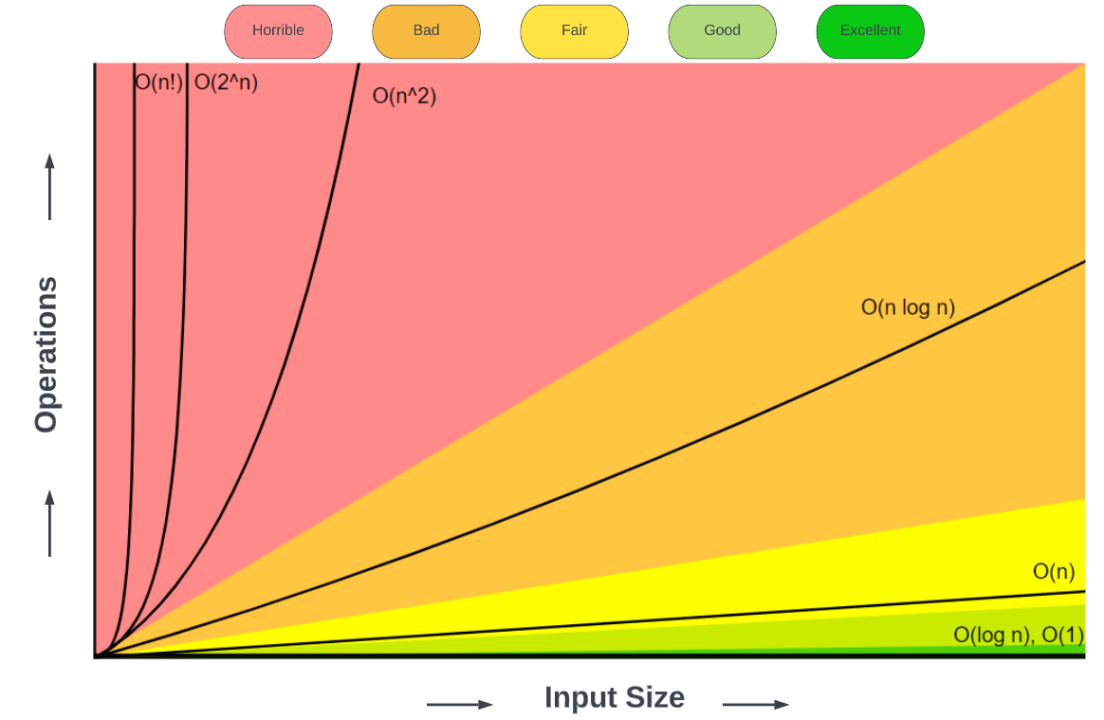
Key Observations from the Complexity Comparison! 📈
- 🟢 O(1) stays perfectly flat
- 🔵 O(log n) grows very slowly
- 🟠 O(n) grows steadily
- 🔴 O(n²) accelerates quickly
- 🟣 O(2ⁿ) explodes exponentially
Experiment 1: A Sorting Race 🏁
Predict the winner! All three methods get copies of the same list of distinct numbers.
| Algorithm | Status | Comparisons | Time |
|---|---|---|---|
| Merge sort | Ready | — | — |
| Bubble sort | Ready | — | — |
| Bogosort (shuffle!) | Ready | — | — |
Bogosort stops after 25,000 shuffles or about 2 seconds, whichever comes first. “Limit reached” means it did not finish in this run—not that it can never finish.
The browser runs JavaScript implementations in separate workers; times exclude worker startup and result checking. Timing varies with the device and concurrent work. Bogosort’s comparisons count sortedness checks, not shuffle operations.
Try it: Double or change the list size; then compare reverse and already-sorted input. What changes?
What Are the Sorting Methods Doing?
- Merge sort: split the list, sort each half, and merge the results. O(n log n).
- Bubble sort: repeatedly compare neighboring values and swap out-of-order pairs. Worst case O(n²); this version stops early if no swaps occur.
- Bogosort: shuffle randomly until the list happens to be sorted. It can finish, but the expected number of shuffles grows roughly as n! for distinct items.
Tip
Discuss: Why is already-sorted input especially good for this bubble sort? Why is the number of shuffles not a reliable prediction for just one bogosort run?
Watch Bubble Sort 🫧
Each step compares neighbors or shows the result. Follow the largest value as it moves right.
Yellow: current neighbors · Green: confirmed final positions
Think: After one pass, where is the largest value? When can we stop early?
Watch Merge Sort 🔀
Follow the recursive splits, then watch sorted halves merge. The display shows the current sublist, not the whole recursion tree.
Current sublist:
Left remaining
Right remaining
Merged output
Think: Why can we append the rest of one half when the other half is empty?
Python: Bubble Sort 🫧
def bubble_sort(items):
    values = items.copy()  # Keep the original list unchanged.
    for end in range(len(values) - 1, 0, -1):
        swapped = False
        for i in range(end):
            if values[i] > values[i + 1]:
                values[i], values[i + 1] = values[i + 1], values[i]
                swapped = True
        if not swapped:
            break
    return values

print(bubble_sort([5, 1, 4, 2, 3]))
How many neighboring comparisons might the nested loops make as the list grows?
Python: Merge Sort 🔀
def merge_sort(items):
    if len(items) < 2:
        return items.copy()
    middle = len(items) // 2
    left = merge_sort(items[:middle])
    right = merge_sort(items[middle:])
    result = []
    i = j = 0
    while i < len(left) and j < len(right):
        if left[i] <= right[j]:
            result.append(left[i])
            i += 1
        else:
            result.append(right[j])
            j += 1
    return result + left[i:] + right[j:]

print(merge_sort([5, 1, 4, 2, 3]))
In everyday Python, also try sorted(items): it uses Python’s built-in sorting algorithm, not this merge sort.
Actually, why is merge sort faster than bubble sort for large lists? How does the number of comparisons grow as the list size doubles? How does this compare to bogosort?
Experiment 2: Find a Number 🔍
Both searches inspect the same sorted list 0, 1, …, n - 1. Predict which examines fewer items.
Target value: —
| Method | Result | Items inspected |
|---|---|---|
| Linear search | Ready | — |
| Binary search | Ready | — |
Counts are inspected items, not elapsed time or individual comparison operators. Creating or sorting the list is not included; binary search requires sorted input.
Try it: Compare first, last, and missing targets. When is a linear search a good choice?
Watch Linear Search 🚶
The same sorted list is used for both search visualizations, though linear search does not require sorting.
Yellow: item just inspected · Crossed out: no longer a candidate
Try it: Find the first item, then a missing item. How many items did you inspect?
Watch Binary Search 🔍
Binary search needs a sorted list. Each inspection can eliminate half of the remaining candidates.
Yellow: item just inspected · Crossed out: no longer a candidate
Try it: Find 15, then 10. Compare the number of inspections with linear search.
Python: Two Ways to Search 🐍
Linear search — works on an unsorted list; O(n) worst case.
Discuss: If the list is unsorted and you search only once, should you sort it first? What if you search it many times?
Challenge: Guess the Complexity Level! 🏗
| Task | Complexity | Justification |
|---|---|---|
| 🧑🍳 Cooking a meal for 4 people | ? | ? |
| 📚 Finding a word in a dictionary | ? | ? |
| 🧬 Exploring family tree generations | ? | ? |
| 🧑🤝🧑 Introducing everyone at a party | ? | ? |
| 🔍 Searching for a name in your phone contacts | ? | ? |
| 🎁 Figuring out gift wrapping combinations for 10 gifts | ? | ? |
| 📖 Reading every page in a book | ? | ? |
Important
The below tasks are all over the place! Define the tasks according to complexity: easiest (O(1)) to hardest (O(2ⁿ)). Work in groups to justify your choices! Be prepared to share with the class! 🚀
Detection of the Daily Complexity 🕵️♂️
Now You’re Ready for the Challenges! 🎯
You’ve learned the 5 complexity levels. Time to become complexity detectives and find examples from your own life! Work in groups to come up with a real world task (that you complete!) for each complexity level. Be prepared to share your findings with the class! 🚀
Remember the Levels! 📋
The 5 Complexity Levels:
- ⚡ O(1) - Magic Trick (always same time)
- 🔍 O(log n) - Smart Detective (cut in half)
- 🚶 O(n) - One-by-One (check everything)
- 🤝 O(n²) - Handshake Problem (everyone meets)
- 💥 O(2ⁿ) - Explosion (choices double work)
Solutions: Arrange Tasks by Complexity Level 🏗
| Task | Complexity | Estimated Steps Needed |
|---|---|---|
| 🧑🍳 Cooking a meal for 4 people | O(n) | n = number of people (or portions) |
| 📚 Finding a word in a dictionary | O(log n) | n = number of words |
| 🧬 Exploring family tree generations | O(2ⁿ) | n = number of generations |
| 🧑🤝🧑 Introducing everyone at a party | O(n²) | n = number of people |
| 🔍 Searching for a name in your phone contacts | O(n) | n = number of contacts |
| 🎁 Figuring out gift wrapping combinations for 10 gifts | O(n!) | n = number of gifts |
| 📖 Reading every page in a book | O(n) | n = number of pages |
Important
Listed according by easiest (O(1)) to hardest (O(2ⁿ))
Justifications of Complexity Levels 🕵️♂️
🧑🍳 Cooking a meal for 4 people → O(n)
n = number of people (or portions) You typically scale ingredients and prep roughly linearly with servings.
📚 Finding a word in a dictionary → O(log n) (if using a sorted dictionary)
n = number of words Like binary search: you repeatedly halve the search space. If unsorted, it would degrade to O(n).
🧬 Exploring family tree generations → O(2ⁿ) (exponential)
n = number of generations Each generation roughly doubles (2 parents, 4 grandparents, etc.).
🧑🤝🧑 Introducing everyone at a party → O(n²) n = number of people If everyone is introduced to everyone else, you get pairwise interactions.
🔍 Searching for a name in your phone contacts → O(n) (typical case)
n = number of contacts Linear scan if unsorted. Could be O(log n) if perfectly sorted and searched efficiently.
🎁 Figuring out gift wrapping combinations for 10 gifts → O(n!) (factorial)
n = number of gifts If considering all possible orderings or combinations of wrapping, this grows extremely fast.
📖 Reading every page in a book → O(n)
n = number of pages You process each page once.
CS 101 - Algorithm Complexities